Dreaming of Mallets
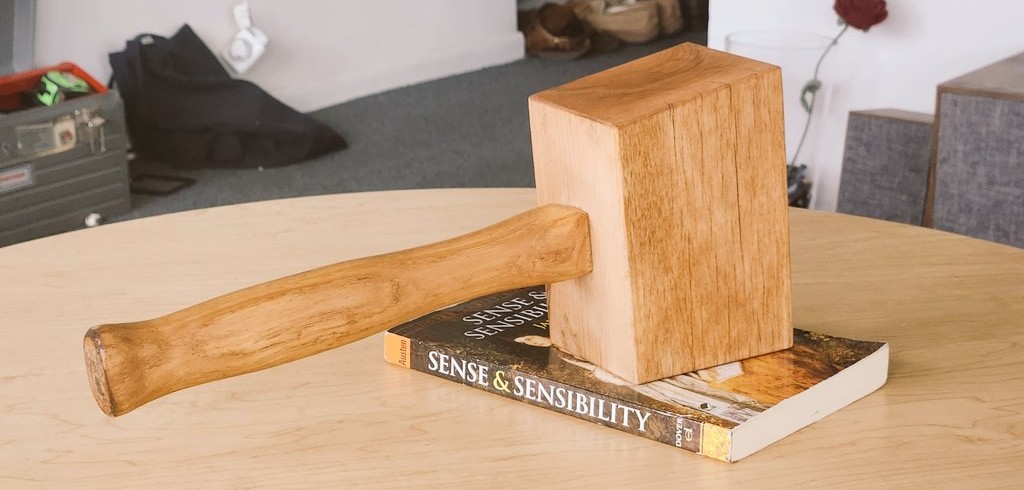
A nice medium heft mallet made of reclaimed lumber.
This is a rehashing/expounding/expansion of a thread I wrote about this mallet I made last year. This article is dated to reflect the development/completion of its contents, not the time of writing.
— central valley odysseus (@sandinbrain) April 2, 2025
Here one can see the finished mallet, as it was immediately after completing construction, sitting atop a copy of Jane Austen’s Sense and Sensibility.
I saw this mallet in a dream, an odd thing to see in a dream perhaps, but I had just seen several videos on mallet construction, including
- Rex Krueger’s video about recreating a vintage mallet, with a head that was once a segment of a wagon wheel,
- Paul Seller’s video on making a Joiners’ mallet,
- and, another I cannot remember, but had the characteristic Japanese style octagonal handle.
With all the prabhavit (influence), it’s no wonder the fascination manifested; it is only natural to dream of one’s desires.
The imagined mallet features a beech head, a hickory handle, and a walnut wedge to pin it, all typical fare for a joiner’s mallet. The handle was to be a tapered octagon, flaring slightly the top to a slight shoulder where it meets the mortise. The sketch shows the head being perfectly trapezoidal, though I noted below that I ought to round the top slightly to “soften the ‘brutalist’ feeling it currently exudes.”
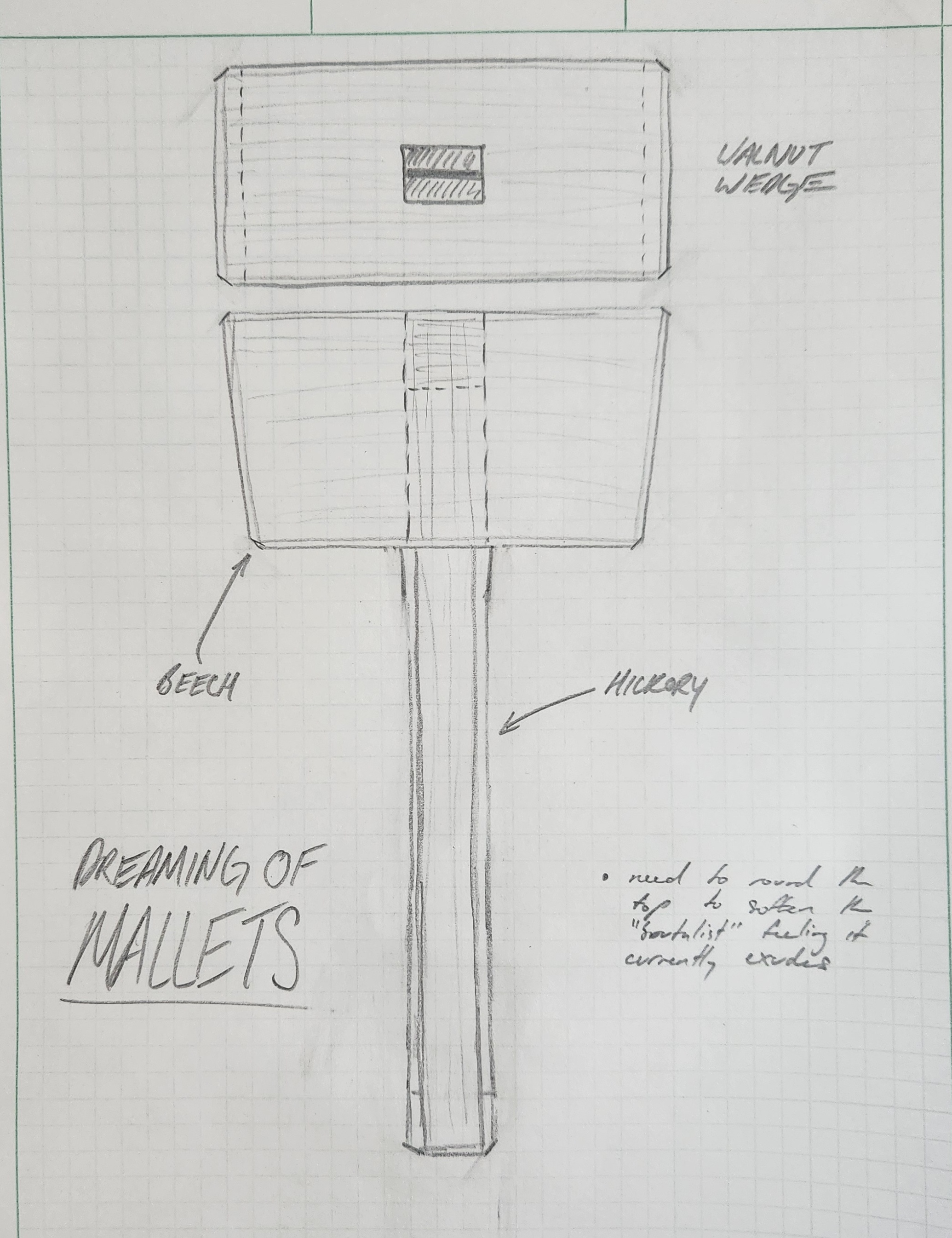
An item like this is hardly a precision instrument, and unshackled from specified dimensions we must hit, the sketch is enough to start working.
I started with the handle, a piece of hickory I saved from the bottom of a broken sledge hammer handle. The girth was plenty that I could plane it to the octagonal taper I wanted without losing much diameter. The first thing I noticed having done so was that the length of the sketched handle is simply too long, this is not to be a bludgeon. No matter, cutting stock to length is usually the last step anyhow. Second, I noticed that all the hammers in my collection that were for more dexterous tasks (ball-peens, finish, brass) had that middle bulge. The single flare base is great for swinging with great force, but not so much for control; the action of a mallet meeting a chisel is more akin to a “drop” than a swing. So, I pulled out the rasps and shaped the handle to a more typical Western style.
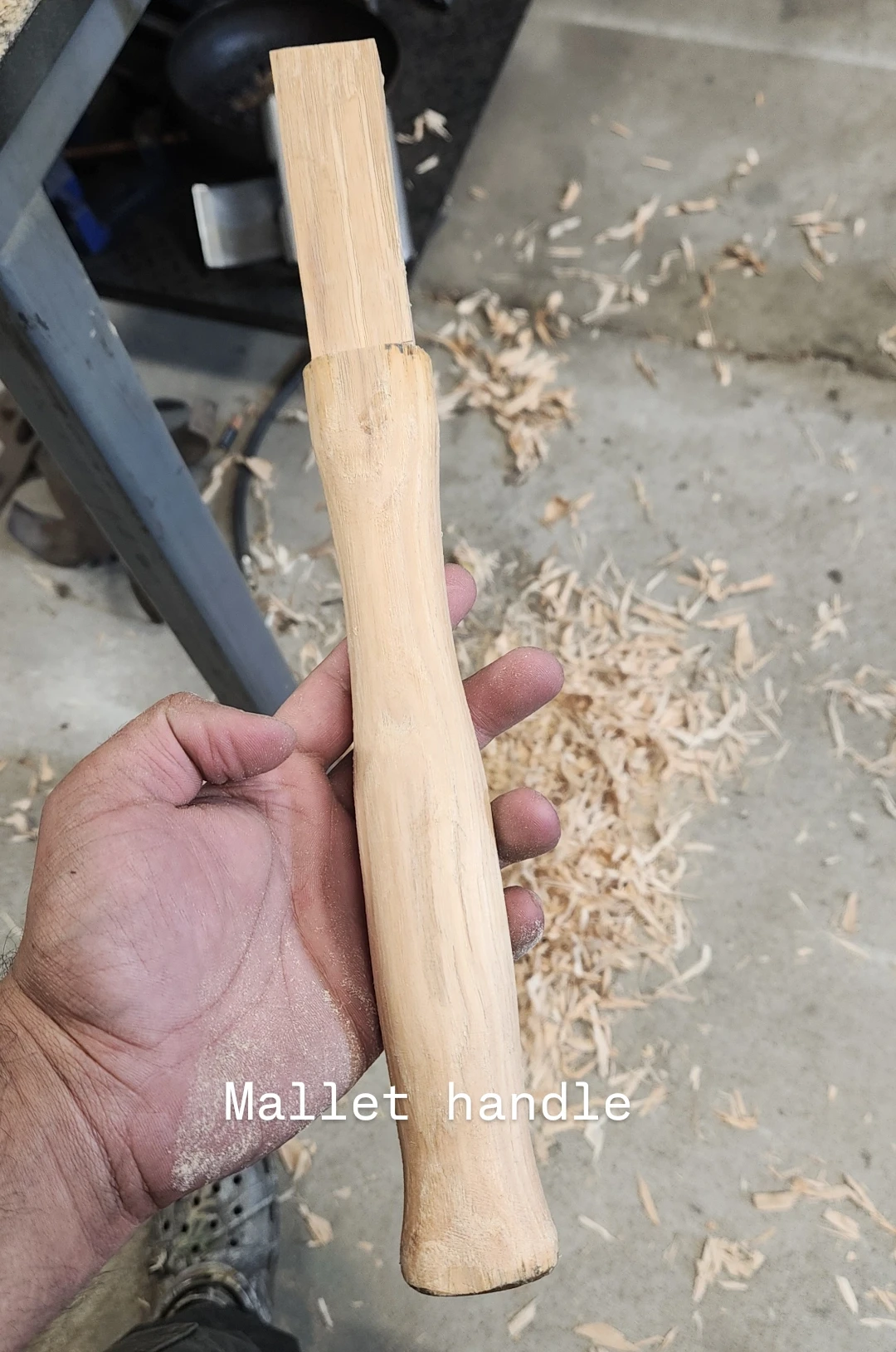
With the handle shaped and tenon cut (a mistake, you’ll see later), I noticed a new flaw. Straight and open-grained woods (ring porous), like the hickory handle, are quite easily cleaved apart. To prevent the handle from splitting along the shoulder of the tenon, I set my chisel bevel down and tapered it to meet the tenon. This has the additional benefit of forcing the head tight down onto the handle, like machining between centers.
The only piece of hardwood stock I had large enough for the head (I did not want to do a lamination) was this old maple beam with some unfortunate checking on one side (opposite what is shown below). There are no shakes so the piece is sound, but the streaky pattern is unfortunate.
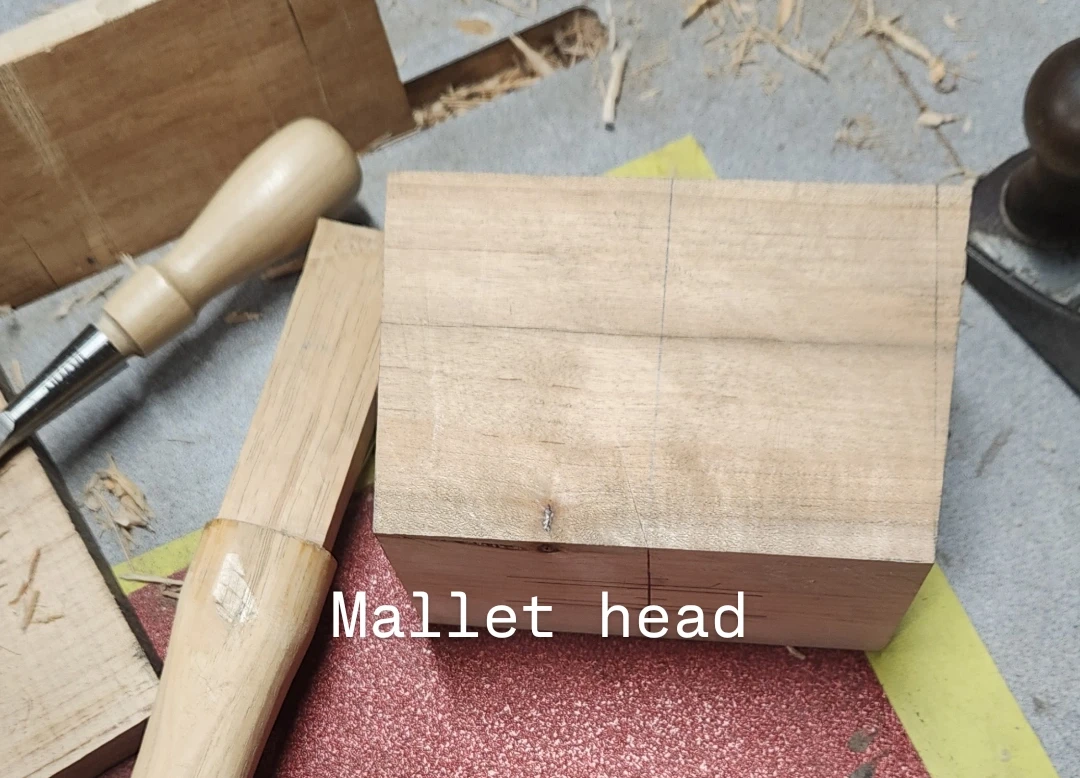
Now for the silly mistake: I did not think to heed the old advice. I foolishly cut the handle tenon before chopping the mortise in the head. It ended up somewhere between 1/2” and 3/4”. I do not have a chisel matching the exact width of the mortise and I was hesitant to cut the tenon to only half an inch across, so I had to chop the mortise first as a 1/2”, then pare away the sides to fit; no big deal, not optimal.
I meant to soft face one side with leather but I got carried away and oiled the whole thing before I remembered, and planing that endgrain down again doesn’t sound fun so I’ll live with it.
All said, it’s a good mallet. Strikes a chisel well without damaging the butt. The face takes on a nice burnish from the impact.
I’ll likely carve one side, but I want to avoid any “Mjolnir” resemblance so I’ll have to think on a suitable design a while.